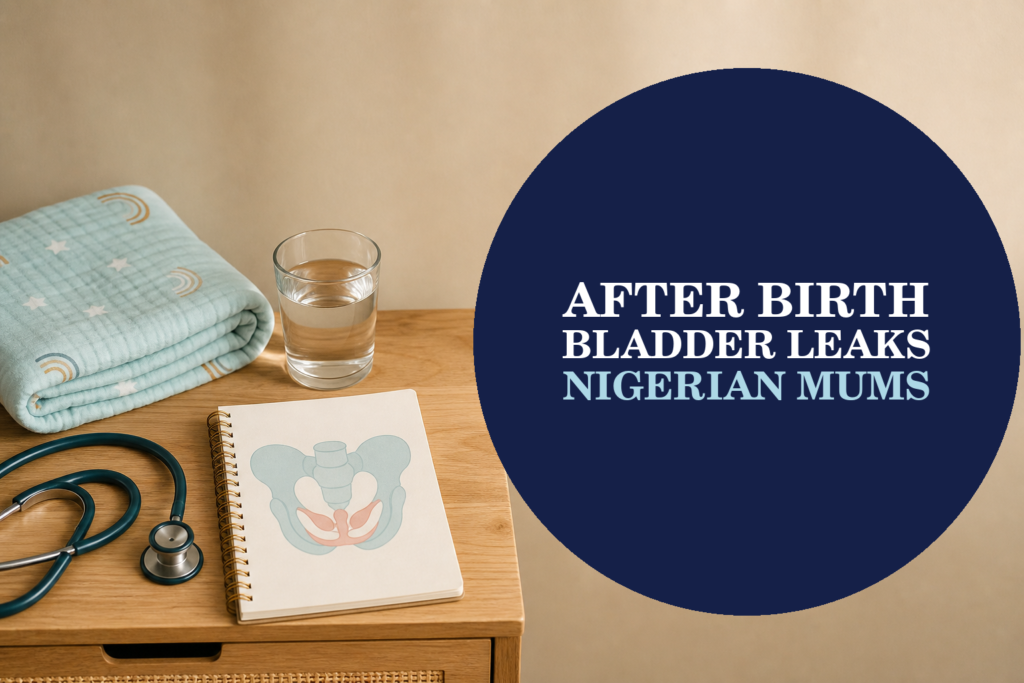
A little urine leakage when you cough, laugh or lift your baby can feel embarrassing, especially when you are already tired from caring for a newborn. You are not alone, and it is not something you have to keep quiet about.
Pregnancy and childbirth place real pressure on the pelvic floor, the group of muscles that supports the bladder, bowel and reproductive organs. In Nigeria, a new mother in Lagos, Enugu or Kano may return quickly to housework, church, work and caring for older children before her body has fully recovered.
Stress incontinence means urine escapes when pressure rises, such as during a cough, sneeze, laugh, run or lift. Urge incontinence is a sudden, difficult-to-delay need to pass urine. Some women experience both.
These symptoms may happen after a vaginal birth or a caesarean birth. A long labour, repeated pregnancies, a larger baby, constipation and pelvic-floor injury can all affect recovery. They are not proof that a mother did anything wrong.
Research in Nigeria has found that postpartum urinary leakage is common but often not reported. A study of women attending a postnatal clinic in Jos found postpartum urinary incontinence in 27.1% of participants. A prospective study published in 2025 also found that delivery circumstances and prolonged pushing can influence the risk.
These figures are a reason to seek support, not a reason to panic. Most importantly, the type and cause of leakage need proper assessment, particularly if it is continuous or began immediately after delivery.
Seek medical advice if leakage is heavy, painful, bloody, associated with fever, or comes with difficulty passing urine. Continuous dripping of urine, especially after a difficult labour, needs prompt assessment because it can have a different cause from ordinary stress incontinence.
Do not let shame delay care. Ask a trusted relative to help with transport to a clinic if needed. A respectful conversation with your partner or family can also give you the time and privacy needed for recovery.
Obioha KC et al. Prevalence and predictors of urinary/anal incontinence after vaginal delivery: prospective study of Nigerian women. International Urogynecology Journal, PubMed: 25894903.
Nnaji HC et al. Effect of Mode of Delivery on Incidence of Urinary and Anal Incontinence after Childbirth. Nigerian Journal of Clinical Practice, 2025, PubMed: 40884328.
International Journal of Medical Science and Dental Health. Prevalence and Risk Factors for Postpartum Urinary Incontinence Among Postnatal Women in a Tertiary Health Care Centre, North Central Nigeria.